Showing posts with label Islam is beautiful. Show all posts

Monday, June 13, 2011

Go Crazy Is Not A Muslim-Style

Don't go flash me with sarcastic look 
"Anger works in mysterious ways, it can keep you awake all night whispering ugly words to you. It can rumble away in your stomach, sapping the energy from you, leaving you distracted and irritable. It almost always becomes irrational as it builds up inside you."-Ten things I hate about me
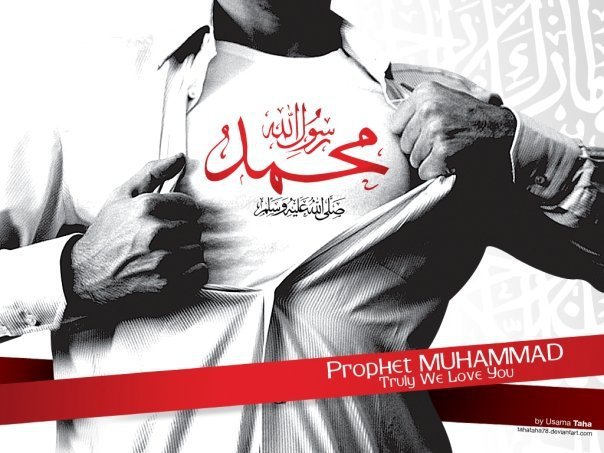
Yes, alright I know, It is undeniable, anger won't change anything but still me upset and feel like my heart plummet on the floor, every time I happened to read or heard people say something bad about Prophet Muhammad SAW :( . It's like a silence volcano within myself, which no one can see it, but waiting the right time to spill off the extremely hot lava! So I chose to voice it up here in my blog to put things straight even a bit. But don't worry, I think I don't reach a level where I need to go for "Anger management" thing, its still under my nerve control, inshaallah. 


So,there is some groups out there, whatever they named it, they loved to write on something that they think they have knowledge on it, they bundled up information from the web, add some mean words here and there to spice things up and roll it up through the net, they don't care whether it is true or not as long as they can make prophet Muhammad sounds so  retarded and ugly, especially due to his multiple marriage and his marriage with 'Aisyah when she's only 10 years old and something like he spreads Islam by swords? Come on, don't attempt to jump to the conclusion when you don't even make a just research on him from a guanine source of information. Ok, lets for a while put aside all the philosophy studies with so many sophisticated terms, let just put thing in a very straight forward and simple way. 

First off, what do you think his purpose to spread Islam? To declared himself as the messenger of Allah who receives through an angel, revelation from the Creator of universe? Is it the power that he wanted the most? Or the wealthy, he expected to gain respect from people so that he can easily manipulated them to give him whatever he asked? Or a woman to fulfill his lusts? 

Power, wealth and women, aren't they the major reasons of people fighting each others? If let say yes, he wanted to have them all, but then why he took so long and why he put himself into hardship, when he resisted the offer from Quraisy at the very beginning at the moment they tried to bribe him in exchange to shut his mouth down from preaching Islam and they willing to give him the power, wealth and women. But why unbelievably, his answer is this, 
“If they put the sun on my right hand and the moon on my left hand, I would still not give up my mission.” 
What makes him so cold about those temptation offers, which people would die to gain them? Logically simple, because he is not on his own mission, he's on Allah's mission, he chose to continue the mission with a very simple moderate life and being a very good example of noble manners. So now, what was his message to people? 
That our God is One, worship Him alone and no other being besides Him. 
Do you think this message sounds like he wants people to give him anything? Or did his message sounds selfish anyways? NO! His people angry and disliked him at the beginning of his preach even they called him as Al-Amin (The trustworthy) before his prophet-hood for his word was respected, his judgement final, because he would never be unjust. He raised from the noblest families and was well-known to his people as a man that  never lied, never worshiped to an idol and never did anything that would disgrace his character.

Yet after 40 years of his age, they called him a liar, a crazy man and a magician. They character assassinated him, but could not prove his message wrong. They have no reply, no answer and no explanation to the words coming out of his mouth. Even the finest and proudest literary geniuses they were, they had never heard a speech more supreme, sublime, intellectual and thought provoking than the Quran and it was being recited by one who could neither read or write.

It was obvious, that the Prophet has no personal political or worldly ambition whatsoever. He was by nature a contemplative. Before being chosen as Prophet, he did not like to frequent social gatherings and activities. He used to lead a caravan from Mecca to Syria passing through the majestic silence of the desert whose very “infinity” induced men towards contemplation. He often spent long periods in the cave of Hira`, in the mountains surrounding Mecca, in solitude and meditation. 


He was  by nature neither a man of  the world nor one who was naturally inclined to seek political power among the Quraysh or social eminence in the Meccan society, although he came from the noblest family. It was in fact very painful and difficult for him to accept the burden of prophecy that implied the founding of not only a new religion but also a new social and political order. All the traditional sources testify to the great hardship the Prophet underwent by being chosen to participate in the active life in its most acute form.The Prophet believed that if his religion is to be an integral part of life, he must try to establish peace in the most profound sense, namely to establish equilibrium between all the existing forces that surrounded him and to overcome all the forces that tended to destroy this equilibrium.

Thus the wars undergone by the Prophet were never aiming to oblige anyone to embrace Islam. The Quran stated the rule of: 
“There is no compulsion in religion” [2:256], 
and emphasized the fact that a person’s belief in Islam or his rejection to believe is a matter that depends upon man’s free will and his sincere conviction. This is stated in hundred of verses like: 
“Let him who will, believe, and let him who will, reject it” [18:129].
The Quran precised the way to be used to invite people to Islam, and it was not war. The Quran says to the Prophet: 
“Invite to the way of your God with wisdom and beautiful preaching; and argue with them in ways that are best and most gracious” [16:125].
So why wars? The Prophet went on to war only when he was obliged to do so against those who were threatening the existence of the newly born community in Medina. He tried to have peace with everybody, with the Meccans, the Arab tribes, the Jews, etc… and when these people were not honoring their pacts concluded with the Muslims, the Prophet went on to war. He did so to protect his community and to allow the people to worship God freely, without oppression or fear.


Multiple marriages, for him, were not so much enjoyments as responsibility and means of integration of the newly founded society. Besides, in Islam, the whole problem of sexuality appears in a different light as it is sacred and is integrated to the equilibrium of life Islam seeks for the human being. The marriages of the Prophet symbolize his patriarchal nature and his function, not as a saint who withdraws from the world, but as one who sanctifies the very life of the world by living it and accepting it with the aim of integrating it into a higher order of reality. 


Let’s peek on how people 1,400 years ago viewed the union between Prophet Mohammed with Aisha and his other wives. Nobody said anything about it. That in, itself, is very significant. The people of Mecca tried their best to disgrace the reputation of the Prophet, calling him a “liar”, accusing him of being possessed, and never letting an opportunity escape when they could ridicule him. Yet, not a single Arab ever said anything about the Prophet’s marriage. No one felt that it was unordinary or strange. So why after 1,400 years, we  really put this thing on the highest concern? Can you feel me? 

The Prophet represents the spirituality of Islam, which is not the rejection of the world but the transcending of it through its integration into a center. So people, don't confused yourself with a bunch of information on the media and simply judge about our Prophet Muhammad SAW, Quran itself could tell you who he really is, Surat at-Tawbah, Ayah 128, highlights the sublimity of the Prophet’s genealogy and status.  Allah said:
{لَقَدْ جَاءَكُمْ رَسُولٌ مِنْ أَنْفُسِكُمْ عَزِيزٌ عَلَيْهِ مَا عَنِتُّمْ حَرِيصٌ عَلَيْكُمْ بِالْمُؤْمِنِينَ رَءُوفٌ رَحِيمٌ}. This ayah means:  [A messenger from among you came who grieves for what is hard on you, who wants very much that which benefits you (the guidance…).  He is very kind and merciful to the believers.]
There is zillion things in my mind, but believe me, none of it is to force you people on my my believe and religion, Islam. Islam is a rational and simple religion, you need to clear off your mind of sarcasm and go to the genuine source, our holy book, Quran and find it yourself about Islam and it's taught. May Allah guides us all, peace out!
 

P/s: I reckon thst, this is the longest post in my blog and I can't go any further, oh am I just underestimated myself? ~_~


Some infos originally from: article Misconceptions about the Prophet Muhammad By Rachida El Diwani and the Quran quotation is of course taken originally from Quran.

Sunday, May 29, 2011

Has Allah Forsaken Me?


Bismillah..Allah brought us into existence, placed us on this earth, provides us with everything we need and gave most of us the ability to choose how to spend our lives. He created us to test us, and we will be rewarded or punished as a result. But when Allah tests us, we always have this sort of  question in our head,"Why God picks me? Why me, why not others?Did he even heard my prayers or has He already forsaken me?" we weep and we almost forget that actually everyone is tested in a different ways or perhaps they're tested with something that much heavier and harder than us. Allah says in Quran:

"Your Lord has not forsaken you, nor has He become displeased. And surely what comes after is better for you than that which has gone before. And soon will your Lord give you so that you shall be well pleased." Surah Ad-Duha [verses 3-5]

Believe it, when Allah takes something from your grasp, He's not punishing you, but merely opening your hands to receive something better. The will of Allah will never take you where the Grace of Allah will not protect you. Chin up, have faith buddies, Allah never leaves us, He is watching us, listening to us and always with us ♥ ♥ ♥

Saturday, May 21, 2011

10 Things we waste


1. Knowledge: Wasted when not taking action with it. 
2. Actions: Wasted when we do anything without sincerity. Intentions count. 
3. Wealth: Wasted when used on things that will not bring us âjr (reward). We waste our money, our status, our authority, on things that have no benefit in this life or in âkhirah (The Hereafter). 
4. Hearts: Wasted when empty from the love of Allah, and the longing for Him/Her, and devoid of peace & contentment. 
5. Bodies: Wasted when we don’t use them in ibâdah (worship) and service of Allah in serving humankind. 
6. Love: Wasted when our emotional love is misdirected, not towards Allah, but towards something/someone else. 
7. Time :Wasted when not used properly, by not doing what is righteous. 
8. Intellect: Wasted on things that are detrimental to society and the individual, not in contemplation or reflection. 
9. Service: Wasted when in service of someone who will not bring us closer to Allah. 
10. Dhikr: Wasted when it does not have an effect on our hearts

Wednesday, May 18, 2011

Being good is useful only when doing good


Bismillah..

While earning your daily bread, be sure you share a slice with those less fortunate. Being good is commendable, but only when it is combined with doing good is it useful. How far you go in life depends on your being tender with the young, compassionate with the aged, sympathetic with the striving and tolerant of the weak and strong.  

Because someday in your life you will have been all of these.Beginning today, treat everyone you meet as if they were going to be dead by midnight.  Extend to them all the care, kindness and understanding you can muster, and do it with no thought of any reward.  Your life will never be the same again. How beautiful a day can be When kindness touches it! 

Good day everyone! :)

Tuesday, May 17, 2011

Be-Fabulous-Forever Muslimah

Sorry if it's your photo sister, can't be help coz it's on the net!


WOow, I was impressed :0 by some women's enthusiasm for make up! They spend their money depend on their level of enthusiasm to buy the make up set, spend hours (For the beginner) or maybe couples of minutes (For the expert) each time they plan to get out, I don't have such incredible patience, I think. Really, I have to make a simple unscientific research on this make ups thingo because I'm not used to it, so let me quickly introduce you with those little miss make up set: 

Very well known, Miss lipstick to magically turned your lips into whatever color you please

Miss Mascara, to curve or even make your eyelashes look longer 


Miss Blusher, to highlight your cheek's bone or to blush up your cheeks

Miss Eye Shadow palettes,  to make a shadow around your eyes, is it? 

Concealer, to of course, perfectly conceal the flaws on your face like pimples or  dark circles and so

Miss Eye liner, to defined the eyes  


Miss Compact powder, widely used among women to protect their faces from direct sunshine attacked


Actually the list is on and on, I was tired to put everything @__@, so here is my straight-forward analysis on make up enthusiasm's level (Which level you belong to?): 

1-Hm dull, low level of enthusiasm -_-

2-Yeah, average level of enthusiasm ~__~

3-Oh, high level of enthusiasm! ^__^


4-Wooot! Super master level of enthusiasm! ^O^
And the result is, tadaaaaa....

Beautiful!

Ok, whatever it is,somehow it makes me feel like, is it that hard to be a woman?Maybe thats why once in my life I want to become a man! You have to look beautiful, you must look flawless, you should make sure your outfit is an up-to-date fashion and so forth. So many things to think about and it just strangles around your outward appearance. For what reason I should reach that worldly standard and who I want to impressed as Allah does not looks on one's appearance. Well, thanks to who that really concerned about my outward looks and offered me a free consultancy on fashion, but sorry, I'm not interested, I'm comfortable to be this way, a simple muslimah, I'm proud with my own fashion which maybe is the D-list in current fashion, well it didn't bothered me at all C: 

I chose , to be my real being, to be simple, to be modest and moderate. I just want to be a good slave to my Creator, I just want to be a person that give a good memory on every person in my life, I want to contribute something for my religion and community and none of it has got to do with my flawless looks face or my fashionable dress unless people started to judge you on how flawless your skin is or how stunning your dress is but Allah never looks on those. 

I won't let those giant cosmetics and fashion industry  whose make a zillion amount of money every month, to tell me on how I should looks or on how I should dress, I'm a free woman. Well, this is my thought, this is my choice, I will never force it on you and for you, it's your choice. Just don't lost in your own enthusiasm. Don't let it makes your life difficult and don't make it as your priority. For me, Islam is beautiful, once you adopted it in your daily life you'll be beautiful as well, yes, as simple as that ladies and you'll be a fabulous-forever muslimah! Inshaallah C:

Friday, August 6, 2010

Why muslim woman wear HIJAB?


‎1.You please Allaah. You are obeying the commands of your Lord when you wear the hijaab and you can expect great rewards in return.

2.It is Allaah’s protection of your natural beauty. You are too precious to be 'on display' for each man to... see.

3.It is Allaah’s preservation of your chastity.

4.Allaah purifies your heart and mind through the hijaab.

5.Allaah beautifies your inner and outer countenance with hijaab. Outwardly your hijaab reflects innocence, purity, modesty, shyness, serenity, contentment and obedience to your Lord. Inwardly you cultivate the same.

6.Allaah defines your femininity through the hijaab. You are a woman who respects her womanhood. Allaah wants you to be respected by others, and for you to respect yourself.

7.Allaah raises your dignity through the hijaab. When a strange man looks at you, he respects you because he sees that you respect yourself.

8.Allaah protects your honour 100% through your hijaab. Men do not gaze at you in a sensual way, they do not approach you in a sensual way, and neither do they speak to you in a sensual way. Rather, a man holds you in high esteem and that is just by one glance at you!

9.Allaah gives you nobility through the hijaab. You are noble not degraded because you covered not naked.

10.Allaah demonstrates your equality as a Muslim woman through the hijaab. Your Lord bestows upon you equal worth as your male counterpart, and gives you a host of beautiful rights and liberties. You express your acceptance of these unique rights by putting on the hijaab.

11.Allaah defines your role as a Muslim woman through the hijaab. You are a someone with important duties. You are a reflection of a woman of action not idle pursuits. You display your sense of direction and purpose through your hijaab. You are someone that people take seriously.

12.Allaah expresses your independence through the hijaab. You are stating clearly that you are an obedient servant of the Greatest Master. You will obey no one else and follow no other way. You are not a slave to any man, nor a slave to any nation. You are free and independent from all man-made systems.

13.Allaah gives you the freedom of movement and expression through the hijaab. You are able to move about and communicate without fear of harassment. Your hijaab gives you a unique confidence.

14.Allaah wants others to treat you – a Muslim woman - with kindness. And the hijaab brings about the best treatment of men towards you.

15.Allaah wants your beauty to be preserved and saved for just one man to enjoy – your husband.

16.Allaah helps you to enjoy a successful marriage through wearing hijaab. Because you reserve your beauty for one man alone, your husband’s love for you increases, he cherishes you more, he respects you more and he honours you more. So your hijaab contributes to a successful and lasting marriage relationship.

17.Allaah brings about peace and stability in the society through the hijaab! Yes this is true! Men do not cause corruption by forming illegal relationships because you - the Muslim woman - calm their passions. When a man looks at you, he feels at ease, not tempted to fornicate…

So a Muslim woman in hijaab is dignified, not dishonoured, noble, not degraded, liberated, not subjugated, purified, not sullied, independent, not a slave, protected, not exposed, respected, not laughed at, confident, not insecure, obedient, not a sinner, a guarded pearl, not a prostitute.

Dear Muslim sister! Come towards the gates of Paradise with us! Fulfill your duties towards Allaah, put on your adornment - put on your hijaab, and race towards Jannah (Paradise) by doing all good actions. You should agree by now that wearing hijaab is extremely beneficial – it must be - because Allaah only commands what is good and believe me dear sister, it is good to obey the commands of your Lord


'Their reward is with their Lord: Gardens of Eden underneath which rivers flow wherein they will dwell for ever; Allaah is pleased with them, and they are pleased with Him; this is (in store) for whoever fears his Lord.' [Sooratul-Bayyinah 98:8]

By: Brother Jibraels Sword

Tuesday, July 20, 2010

Miss Jannah Wannabe


Dear sisters in Islam, here the truly honoured woman that we should follow her step on live a life. 
The story of Fatimah Az-Zahrah R.A, beloved princess of Muhammad SAW.


What better example of a women is there than the daughter of the Prophet (s.w.a), Fatimah az-Zahrah (r.a)? When she saw that her father was constantly saying, “O my Community,” she wanted to do something herself for the benefit of this Community. when God ordered the Prophet s.w.a to find a husband for his daughter, the Prophet s.w.a called all the Companions without discrimination and said to them, “God has ordered me to say that whoever recites the Quran from beginning to end tonight may marry my daughter Fatimah, if she consents.”

That night, all the Companions tried to recite the Quran from beginning to end. All stayed at the mosque trying to finish except Ali ibn Abi Talib (r.a) who went home and slept. Everyone, including the blessed
Prophet (s.w.a) assembled in the mosque when Bilal (r.a) recited the call for the dawn prayer. After performing the dawn prayer, Prophet Muhammad (s.w.a) asked, who finished the Quran last night so that I can marry him to my daughter Fatimah?” No one was able to answer, because it is very difficult to finish the thirty parts of the Quran in only seven or eight hours.

Ali ibn Abi Talib (r.a) said, “O Messenger of God, I finished reciting the Quran last night.”

The other Companions looked at him and said, “How is it that you finished the Quran? You slept all night.”

He said, “No, I completed Quran from beginning to end.”

The Prophet (s.w.a) said to Ali (r.a) “Who is your witness?”

Ali (r.a) said, “God is my witness and you, O Prophet (s.w.a), are my witness that I completed it. O Messenger of God, I recited the following: “There is no God but God, Muhammad is the Messenger of God” three times; “I seek the forgiveness of God” seventy times; the Opening Chapter once; the Chapter
of Sincerity three times; the Chapter of the Dawn once; then the Chapter of Humanity once; There is no god but God” ten times ; and ten times “Peace and the blessings of God be upon Muhammad and his family.”

The Prophet (s.w.a) said, “As God bears witness, I also bear witness that Ali has completed the Quran.” If you recite what he recited, it is equivalent to having completed the Quran.”

The Prophet (s.w.a.) asked Fatimah (r.a), “o Fatimah, do you accept Ali as your husband?”

She said, “On one condition.”

All the Companions looked at Ali (r.a), at Fatimah (r.a), and at the Prophet (s.w.a). the Prophet’s face changed as he wondered why Fatimah (r.a) said this? What could the condition be? The angel Gabriel (a.s) came and told him, “O Prophet, do not make a quick decision concerning her. God is telling you to
ask her what her condition is.”

The Prophet (s.w.a) said, “O Fatimah, what is your condition?”

She said, “The condition does not concern Ali, but it is related to me. If that condition is fulfilled, I will accept. If not, I will never accept to marry Ali.”

Again, the angel Gabriel (a.s) came to the Prophet (s.w.a) saying, “God is ordering you to ask her what her condition is.” Now look at what God had put into her heart and consider the benefit and station of women in spirituality.

The Prophet (s.w.a) said, “O Fatimah, what is your condition?”

She said, “I hear you continuously, day and night, praying for your Community. You say “O my Lord! Give me permission to lead my Community to you! Forgive them! Purify them! Take away their sins,
difficulties and burdens!” I hear you, and know how much you suffer for your Community. I know from what you have said that when you pass away, you will still be saying, “My Community!” before your Lord, in your grave, and on the Judgement Day. My father, I see you suffering so much for your Community. Since that love of your Community is also in my heart, I want your Community as my dowry. If you accept, I will marry Ali.”


She asked for all of the Prophet’s Community, everyone without discrimination. What was the Prophet (s.w.a) going to say? It was not in his hand to give such a dowry. He waited for Gabriel (a.s), but Gabriel did not come quickly. He kept him waiting for some time, then came and said,
 
“God sends you His greetings and accepts Fatimah’s request. He gives her what she asked for her dowry to marry Ali,” the Prophet (s.w.a) immediately stood up and performed two rakats of prostrations of thankfulness to his Lord.

Fatimah (r.a) was only concerned for the salvation of the Community of the Prophet (s.w.a). No one is going to be outside of her dowry because if God removes one person from the dowry, it will be as if her marriage to Ali (r.a) had been invalid. Therefore, she is going to take the entire Community under her wing and they shall enter with her into Paradise.


This is from the power of one Muslim woman. She will take everyone with her into Paradise.

What about other such women in islam? What will their power be? What about saints? What about prophets? God has created human beings pure. He keeps them pure with such power as that of the Prophet (s.w.a), Abu Bakr (r.a) Umar (r.a) Uthman (r.a), Ali (r.a), and especially our grandmother, Fatimah az-Zahrah (r.a), as well as our Grandshaykh, our Shaykh, and the masters of the Naqshbandi Order and other orders.

May God guide us and all seekers in the Way of Divine Love and the Divine Presence.

Women are honoured to carry themselves the greatest secret - that of human life.

Jalaluddin Rumi wrote:

The Prophet, to whose speech the whole world was enslaved,
Used to say, “Speak to me, O Aisha!”
The Prophet said that women dominate men of intellect
and Possessors of hearts,
but ignorant men dominate women,
for they are shackled by the ferocity of animals.
They have no kindness, gentleness, or love,
Since animality dominates their nature.
Love and kindness are human attributes,
Anger and sensuality belong to the animal.
She is not your “Sweetheart” – She is the radiance of God!


Shaykh Muhammad Hisham Kabbani
Chairman, Islamic Supreme Council of America
Washington, D.C.

Wednesday, June 30, 2010

Tips on teaching children to pray


Children just like a blank piece of cloth, the parents play an important role as a designer on decorating the cloth. For a muslim, pray is a pillar of Islam, its the most basic but crucial pillar that we must teach the children.
Abdullah ibn Amr ibn al-Asr, narrated that the Apostle of Allah (peace be upon him) said,
“Command your children to make salah when they become seven years old…” Abu Dawud
This does not mean that parents can only start teaching their children how to perform it when they reach the age of seven. Rather, informal instruction should start when a child starts to show an interest in salah, which usually occurs around the age of two. It is only human nature that children love to imitate their parents. In fact, this is one method that Allah has provided us for teaching our youth.
Here are some quick tips:
  • Informal teaching should start when child starts to show interest usually occurs around the age of two.
  • Let them pretend to make salah.
  • Invite them to pray along side and join the family jemaah prayer.
  • At a young age, children usually imitate what they see, so it is important to always pray in front of them
  • One of the first steps is to learn al-Fatihah which should begin around the age of three or four. Break down the instructions by using reasonable number of verses or small segments.
  • The practice session should only last between 5 to 15 minutes. At this age consistency is more important than length of practice.
  • Remind them that they are praying to Allah to thank him for all He has given them
  • Important to remember that not all children are ready at the same time and that not everyday will the child be ready to learn new materials.
  • Educational products can assist parents in achieving success with their children because children generally learn in different ways therefore introduction of material through different format (video, coloring book, going to the masjid) will help ease and reinforce the learning process.
  • One of the most important thing that a parent should do is to praise the child for each accomplished task and encouragement to achieve more success.
In a hadeeth narrated by Abdullah ibn Qart the Messenger of Allah (saws) said,
“The first act that the servant of Allah will be accountable for on the Day of Judgment will be salah. If it is good, then the rest of his acts will be good. And if it is evil, then the rest of his acts will be evil.” (Tabarani).

Thursday, June 24, 2010

Do hearts have connections to one another?


Do hearts have connections to one another?

Sometimes, a person happens to meet someone whom he or she immediately loves and spontaneously develops some sort of affinity with. The reverse can apply when the same person meets up with another person. The point is one does not know the reason why one feels good toward some people and feels bad toward others. Is there some sort of connection between their souls?

`A'ishah, the Prophet's wife, narrated a hadith, thatshe heard from the Prophet (peace and blessings be upon him), which gives us a glimpse of the nature of the soul and clears some of the vague feelings that we might find:

"Souls are like conscripted soldiers; those whom they recognize, they get along with, and those whom they do not recognize, they will not get along with" (Al-Bukhari).

Also Abu Hurairah reported Allah's Messenger (peace and blessings be upon him) as saying,

"Souls are troops collected together and those who familiarized with each other (in the heaven from where these come) would have affinity, with one another (in the world) and those amongst them who opposed each other (in the Heaven) would also be divergent (in the world)." (Muslim)
Sometimes the Prophet (peace and blessings be upon him) gives us a glimpse of insight into the realm of the soul, which we know very little about. The important thing to remember in this connection is that Allah has chosen not to give us a detailed knowledge of the soul. We should also remember that whatever He has chosen to withhold from us would not affect our role on earth and the fulfillment of the task assigned to us in this life. Therefore, we limit ourselves to what is outlined in the Qur'an and what the Prophet has given us in authentic hadith.

Almighty Allah says,
(And they ask you about the soul. Say: The soul is one of the commands of my Lord, and you are not given aught of knowledge but a little.)(Al-Israa' 17: 85)
However, people continue to try to explore the realm of the soul and come up with all sorts of ideas to show that they have special knowledge that is denied to others. All such claims are false, because they do not rely on any confirmed knowledge imparted to us by Allah through His messenger.

This hadith has several versions with different chains of transmission, all of which are authentic. This makes it highly authentic. One version that throws some light on its meaning mentions that a woman —known to have a sense of humor and to play tricks — from Makkah traveled to Madinah where she was a guest of a woman of similar qualities. When `A'ishah heard of that, she said, "My beloved husband always told the truth (and she quoted the hadith)."
What this hadith means is that Allah created souls and gave them their qualities. Those of similar qualities will easily be friends when they meet in this life, while those who have different natures are likely to be in conflict. This in fact accounts for endless cases of people getting along together when their apparent circumstances should have kept them well apart. Moreover, it tells us something about what brings good people together and what allows evil ones to flock together and even trust one another, when they know that they are evil at heart.
Ibn Hajar (may Allah have mercy on him) said in his commentary on the hadith "Concerning the phrase 'Souls are like conscripted soldiers…',

This may refer to their similarity as regards good or evil, righteousness or corruption. Good people are inclined towards other good people, and evil people are similarly inclined towards other evil people. Souls feel affinity with others according to the nature in which they were created, good or evil. If souls' natures are similar, they will get along, otherwise they will not be on good terms with one another. It could have happened in the beginning of creation in the realm of the unseen when souls were created before bodies, and used to meet one another. When souls have entered bodies (come to the physical realm) they may recognize one another from the past, and may be on friendly terms or otherwise based on that past experience
Al-Khattaabi also commented this hadith,

This getting along with one another has to do with what Allah decreed from the outset about the ultimate destiny of souls, whether they will be among the blessed (in Paradise) or the doomed (in Hell). Souls are of two opposing kinds, and when they meet in this physical world, they will either love or hate one another depending on the way they were created. Good souls will be inclined towards other good souls, and evil souls will be inclined towards other evil souls.
Thus, the souls of righteous people have connection as if they are recruited due to the purification in their hearts; on the contrary, the souls of devils — both humans and Jinn — have connection since they have the same evil thoughts.

That is why Allah says about the believers, (And (moreover) He hath put affection between their hearts.) (Al-Anfal 8:63)

But when talking about the devils of Jinn and human beings, Almighty Allah says,
(Shall I inform you (of him) upon whom the Shaitans(devils) descend? They descend upon every lying, sinful one.) (Ash-Shu`araa' 26: 221-222)
The Almighty also says,

(And thus do We make some of the iniquitous to befriend others on account of what they earned.) (Al-An`am6:129)

That is why when a believer meets wrongdoers or corrupt people, he or she does not feel at ease and finds it difficult to get along with them because of their sinful deeds; their souls act like oil and water that never mix

Wednesday, May 12, 2010

Prophet Muhammad SAW ideal husband, father and grandfather


Muslim Intellectual - Turkey


Prophet Muhammad personifies the roles of perfect father and husband. He was so kind and tolerant with his wives that they could not envisage their lives without him, nor did they want to live away from him. He married Sawdah, his second wife, while in Makkah. After a while, he wanted to divorce her for certain reasons. She was extremely upset at this news and implored him, "O Messenger of Allah, I wish no worldly thing of you. I will sacrifice the time allocated to me if you don't want to visit me. But please don't deprive me of being your wife. I want to go to the hereafter as your wife. I care for nothing else" (Muslim).

The Messenger did not divorce her, nor did he stop visiting her.
Once he noticed that Hafsah was uncomfortable over their financial situation. "If she wishes, I may set her free," he said, or something to that effect. This suggestion so alarmed her that she requested mediators to persuade him not to do so. He kept his faithful friend's daughter as his trusted wife.
Separation Calamity
All of his wives viewed separation from the Messenger of Allah as a calamity, so firmly had he established himself in their hearts. They were completely at one with him. They shared in his blessed, mild, and natural life. If he had left them, they would have died of despair. If he had divorced one of them, she would have waited at his doorstep until the Last Day.
After his death, there was much yearning and a great deal of grief. Abu Bakr and `Umar found the Messenger's wives weeping whenever they visited them. Their weeping seemed to continue for the rest of their lives. Muhammad left an everlasting impression on everyone. At one point, he had nine wives and dealt equally with all of them and without any serious problems. He was a kind and gentle husband, and never behaved harshly or rudely. In short, he was the perfect husband.
Each of his wives thought that she was his most beloved.
A few days before his death, he said, "A servant has been allowed to choose this world or his Lord. He chose his Lord" (Al-Bukhari). Abu Bakr, intelligent and smart, began to cry, understanding that the Prophet was talking about himself. His illness got worse daily, and his severe headache caused him to writhe in pain. But even during this difficult period, he continued to treat his wives with kindness and gentleness. He asked for permission to stay in one room, as he had no strength to visit them one by one. His wives agreed, and the Messenger spent his last days in `A'ishah's room.
Most Beloved
Each wife, because of his generosity and kindness, thought she was his most beloved. The idea that any man could show complete equality and fairness in his relationships with nine women seems impossible. For this reason, the Messenger of Allah asked God's pardon for any unintentional leanings. He would pray, "I may have unintentionally shown more love to one of them than the others, and this would be injustice. So, O Lord, I take refuge in Your grace for those things beyond my power." (At-Tirmidhi).
What gentleness and sensitivity! I wonder if anyone else could show such kindness to his children or spouses. When people manage to cover up their lower inborn tendencies, it is as if they have done something very clever and shown tremendous willpower. But they sometimes expose these very defects unconsciously while bragging of their cleverness. The Messenger, despite showing no fault, sought only God's forgiveness.
His gentleness penetrated his wives' souls so deeply that his departure led to what they must have felt to be an unbridgeable separation. They did not commit suicide, as Islam forbids it, but their lives now became full of endless sorrow and ceaseless tears.
The Messenger was kind and gentle to all women, and advised all other men to follow him in this regard. Sa`d ibn Abi Waqqas described his kindness as follows:
`Umar said: One day I went to the Prophet and saw him smiling. "May God make you smile forever, O Messenger of God," I said, and asked why he was smiling. "I smile at those women. They were chatting in front of me before you came. When they heard your voice, they all vanished," he answered still smiling. On hearing this answer, I raised my voice and told them, "O enemies of your own selves, you are scared of me, but you are not scared of the Messenger of God, and you don't show respect to him." "You are hard-hearted and strict," they replied. (Al-Bukhari )
The Messenger discussed matters with his wives as friends.
`Umar also was gentle to women. However, the most handsome man looks ugly when compared to Joseph's beauty. Likewise, `Umar's gentleness and sensitivity seem like violence and severity when compared to those of the Prophet. The women had seen the Messenger's gentleness, sensitivity, and kindness, and so regarded `Umar as strict and severe. Yet `Umar shouldered the caliphate perfectly and became one of the greatest examples after the Prophet. He was a just ruler and strove to distinguish right from wrong. His qualities enabled him to be caliph. Some of his qualities might seem rather severe; however, those very qualities enabled him to shoulder very demanding responsibilities.
Consultation
The Prophet did consult with his wives. The Messenger discussed matters with his wives as friends. Certainly he did not need their advice, since he was directed by revelation. However, he wanted to teach his nation that Muslim men were to give women every consideration. This was quite a radical idea in his time, as it is today in many parts of the world. He began teaching his people through his own relationship with his wives.
For example, the conditions laid down in the Treaty of Hudaybiyah disappointed and enraged many Muslims, for one condition stipulated that they could not make the pilgrimage that year. They wanted to reject the treaty, continue on to Makkah, and face the possible consequences. But the Messenger ordered them to slaughter their sacrificial animals and take off their pilgrim attire. Some Companions hesitated, hoping that he would change his mind. He repeated his order, but they continued to hesitate. They did not oppose him; rather, they still hoped he might change his mind, for they had set out with the intention of pilgrimage and did not want to stop half way.
Noticing this reluctance, the Prophet returned to his tent and asked Umm Salamah, his wife accompanying him at that time, what she thought of the situation. So she told him, fully aware that he did not need her advice. In doing this, he taught Muslim men an important social lesson: There is nothing wrong with exchanging ideas with women on important matters, or on any matters at all.
She said, "O Messenger of God, don't repeat your order. They may resist and thereby perish. Slaughter your sacrificial animal and change out of your pilgrim attire. They will obey you, willingly or not, when they see that your order is final" (Al-Bukhari).
He immediately took a knife in his hand, went outside, and began to slaughter his sheep. The Companions began to do the same, for now it was clear that his order would not be changed.
The Messenger encouraged us through his enlightening example to behave kindly with women.
Counsel and consultation, like every good deed, were practiced by God's Messenger first within his own family and then in the wider community. Even today, we understand so little about his relationships with his wives that it is as if we are wandering aimlessly around a plot of land, unaware of the vast treasure buried below our feet.
Two Halves
Women are secondary beings in the minds of many, including those self-appointed defenders of women's rights as well as many self-proclaimed Muslim men. In Islam, a woman is part of a whole, a part that renders the other half useful. We believe that when the two halves come together, the true unity of a human being appears. When this unity does not exist, humanity does not exist - nor can prophethood, sainthood, or even Islam.
Our Prophet encouraged us through his enlightening words to behave kindly to women. He declared, "The most perfect believers are the best in character, and the best of you are the kindest to their families" (Abu Dawud and At-Tirmidhi). It is clear that women have received the true honor and respect they deserve, not just in theory but in actual practice, only once in history - during the period of Prophet Muhammad.
This World or the Next
The wives of the Messenger were given the choice of remaining with him or leaving:
[O Prophet, say to your wives: "If you desire the life of this world and its glitter, then come! I will provide for your enjoyment and set you free in a handsome manner. But if you seek God, His Messenger, and the Home of the Hereafter, verily God has prepared for you, the well-doers among you, a great reward."] (Al-Ahzab 33:29)
A few of his wives who wanted a more prosperous life asked, "Couldn't we live a little more luxuriously, like other Muslims do? Couldn't we have at least a bowl of soup every day, or some prettier garments?" At first sight, such wishes might be considered fair and just. However, they were members of the family that was to be an example for all Muslim families until the Last Day.
The Messenger reacted by going into retreat. The news spread, and everyone rushed to the mosque and began to cry. The smallest grief felt by their beloved Messenger was enough to bring them all to tears, and even the smallest incident in his life would disturb them. Abu Bakr and `Umar, seeing the event in a different light as their daughters were directly involved, rushed to the mosque. They wanted to see him, but he would not leave his retreat. Eventually, on their third attempt, they gained entry and began to rebuke their daughters. The Messenger saw what was happening, but only said, "I cannot afford what they want" (Muslim).
The Qur'an declared [O wives of the Prophet! You are not like any other women] (Al-Ahzab 33:32).
Others might save themselves by simply fulfilling their obligations, but those who were at the very center of Islam had to devote themselves fully so that no weakness would appear at the center. There were advantages in being the Prophet's wives, but these advantages brought responsibilities and potential risks. The Messenger was preparing them as exemplars for all present and future Muslim women. He was especially worried that they might enjoy the reward for their good deeds in this world and thereby be included in [You have exhausted your share of the good things in your life of the world and sought comfort in them](Al-Ahqaf 46:20).
Life in the Prophet's house was uncomfortable. For this reason, either explicitly or implicitly, his wives made some modest demands. As their status was unique, they were not expected to enjoy themselves in a worldly sense. Some godly people laugh only a few times during their lives; others never fill their stomachs. For example, Fudayl ibn `Iyad never laughed. He smiled only once, and those who saw him do so asked him why he smiled, for they were greatly surprised. He told them, "Today I learned that my son `Ali died. I was happy to hear that God had loved him, and so I smiled" (Abu Nu`aym, Hilyat al-Awliya'). If there were such people outside of the Prophet's household, his wives, who were even more pious and respectful of God and regarded as Mothers of the Believers, would certainly be of a higher degree.
It is not easy to merit being together with the Messenger in this world and the hereafter. Thus, these special women were put to a great test. The Messenger allowed them to choose his poor home or the world's luxury. If they chose the world, he would give them whatever they wanted and then dissolve his marriage with them. If they chose God and His Messenger, they had to be content with their lives. This was a peculiarity of his family. Since this family was unique, its members had to be unique. The head of the family was chosen, as were the wives and children.
The Messenger first called `A'ishah and said, "I want to discuss something with you. You'd better talk with your parents before making a decision." Then he recited the verses mentioned above. Her decision was exactly as expected from a truthful daughter of a truthful father: "O Messenger of Allah, do I need to talk with my parents? By Allah, I choose Allah and His Messenger" (Muslim).
`A'ishah herself tells us what happened next: "The Messenger received the same answer from all his wives. No one expressed a different opinion. They all said what I had said." They did so because they were all at one with the Messenger. They could not differ. If the Messenger had told them to fast for a lifetime without break, they would have done so and endured it with pleasure. However, they endured hardship until their deaths.
Some of his wives had enjoyed an extravagant lifestyle before their marriage to him. One of these was Safiyyah, who had lost her father and husband and had been taken prisoner during the Battle of Khaybar. She must have been very angry with the Messenger, but when she saw him, her feelings changed completely. She endured the same destiny as the other wives. They endured it because love of the Messenger had penetrated their hearts.
Mothers of the Believers
The Messenger was the perfect head of a family.
Safiyyah was a Jew. Once, she was dismayed when this fact was mentioned to her sarcastically. She informed the Messenger, expressing her sadness. He comforted her saying, "If they repeat it, tell them, 'My father is Prophet Aaron, my uncle is Prophet Moses, and my husband is, as you see, Prophet Muhammad, the Chosen One. What do you have more than me to be proud of?'"
The Qur'an declares that his wives are the Mothers of the Believers (Al-Ahzab 33:6). Although 14 centuries have passed, we still feel delight in saying "my mother" when referring to Khadijah, `A'ishah, Umm Salamah, Hafsah, and his other wives. We feel this because of him. Some feel more love for these women than they do for their real mothers. Certainly, this feeling must have been deeper, warmer, and stronger in the Prophet's own time.
The Messenger was the perfect head of a family. Managing many women with ease, being a lover of their hearts, an instructor of their minds, an educator of their souls, he never neglected the affairs of the nation or compromised his duties.

The Messenger excelled in every area of life. People should not compare him to themselves or to the so-called great personalities of their age. Researchers should look at him, the one to whom angels are grateful, always remembering that he excelled in every way. If they want to look for Muhammad they must search for him in his own dimensions. Our imaginations cannot reach him, for we do not even know how to imagine properly. God bestowed upon him, as His special favor, superiority in every field.
Ideal Father & Grandfather
Prophet Muhammad was an extraordinary husband, a perfect father, and a unique grandfather. He was unique in every way. He treated his children and grandchildren with great compassion, and never neglected to direct them to the straight path and to good deeds. He loved them and treated them tenderly, but did not allow them to neglect matters related to the afterlife. He showed them how to lead a humane life, and never allowed them to neglect their religious duties or to become spoiled. His ultimate goal was to prepare them for the hereafter. His perfect balance in such matters is another dimension of his divinely inspired intellect.
Anas ibn Malik, the Messenger's servant for 10 continuous years, says, "I have never seen a man who was more compassionate to his family members than Muhammad." (Muslim) If this admission were made just by us, it could be dismissed as unimportant. However, millions of people, so benign and compassionate that they would not even offend an ant, declare that he embraced everything with compassion. He was a human like us, but God inspired in him such an intimate affection for every living thing that he could establish a connection with all of them. As a result, he was full of extraordinary affection toward his family members and others.
All of the Prophet's sons died. Ibrahim, his last son, died in infancy. The Prophet often visited his son before the latter's death, although the Prophet was very busy. Ibrahim was looked after by a nurse. The Prophet would kiss and play with him before returning home. (Muslim) When Ibrahim took his last breaths, the eyes of the Prophet started shedding tears. `Abdur-Rahman ibn `Awf said, "O Allah's Messenger, even you (weep)!" The Prophet said, "O Ibn `Auf, this is mercy." Then he wept more and said, "The eyes shed tears and the heart grieves, and we will not say except what pleases our Lord, O Ibrahim ! Indeed we are grieved by your separation." (Al-Bukhari)
The Messenger was completely balanced in the way he brought up his children. He loved his children and grandchildren very much, and instilled love in them. However, he never let his love for them be abused. None of them deliberately dared to do anything wrong. If they made an unintentional mistake, the Messenger's protection prevented them from going even slightly astray. He did this by wrapping them in love and an aura of dignity. For example, once Hasan or Husain wanted to eat a date that had been given to be distributed among the poor as alms. The Messenger immediately took it from his hand, and said, "Anything given as alms is forbidden to us." (Ibn Hanbal, Muslim) In teaching them while they were young to be sensitive to forbidden acts, he established an important principle of education.
Whenever he returned to Madinah, he would carry children on his mount. On such occasions, the Messenger embraced not only his grandchildren but also those in his house and those nearby. He conquered their hearts through his compassion. He loved all children.
He loved his granddaughter Umamah. He often went out with her on his shoulders, and even placed her on his shoulders while praying. When he prostrated, he put her down; when he had finished praying, he placed her on his back again. (Muslim) He showed this degree of love to Umamah to teach his male followers how to treat girls. This was a vital necessity; only a decade earlier, it had been the social norm to bury infant or young girls alive. Such public paternal affection for a granddaughter had never been seen before in Arabia.
The Messenger proclaimed that Islam allows no discrimination between son and daughter. How could there be? One is Muhammad, the other is Khadijah; one is Adam, the other is Eve; one is 'Ali, the other is Fatima. For every great man there is a great woman.
As soon as Fatimah, the daughter of the Messenger, entered the room where the Messenger was, he would stand, take her hands, and make her sit where he was sitting. He would ask about her health and family, show his paternal love for her, and compliment her.
Fatimah, knowing how fond he was of her, loved him more than her own self. Her great mission was to be the seed for godly people. She always watched her father and how he called people to Islam. She wept and groaned when the Messenger told her that he would die soon, and rejoiced when he told her that she would be the first family member to follow him. (Al-Bukhari and Muslim) Her father loved her, and she loved her father.

Our Long Journey

Daisypath Anniversary tickers

ShareThis

Need He